Turn a mixed cabinet into a sorted collection
Start at the top of a rod
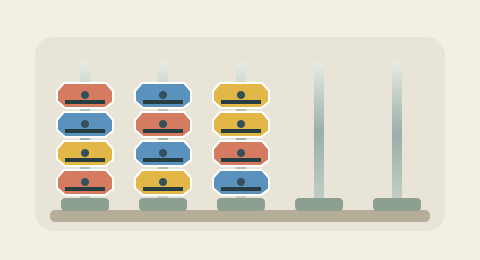
Select a rod to pick its top nut, then select another rod as the destination. Only the top nut can move; the ones beneath it have to wait. A destination is legal when it has spare capacity and is either empty or topped by the same kind of nut. Each move transfers exactly one nut. Clicking a different occupied rod that is not a legal destination selects that rod instead, letting you change your plan without spending a move.
Finish with full, uniform rods
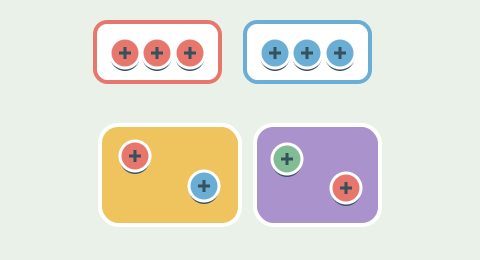
The goal is to fill each occupied rod with one kind of nut. Spare rods may remain empty. A completed rod stays on the cabinet rather than disappearing, so finishing one color does not create unlimited extra space. Completed rods are not locked: if you need to move their top nut again, the normal rules still apply. The progress indicators count completely sorted rods, and progress can decrease if you deliberately reopen one.
BEFOREBlue is on top of gold
AFTERMove blue onto blue
An empty rod is working space
The cabinet contains more total capacity than the nuts require. That reserve lets you temporarily move a top nut to reach the one underneath. The way this spare capacity is distributed matters. Several partially full rods do not always give you the same options as an entirely empty rod, because only matching top colors can share a nonempty destination. Look for a sequence that keeps a useful destination available for the next buried color.
A practical sorting decision
Suppose a gold nut sits beneath a blue nut, while your gold destination is ready. Moving the blue nut away is the first task. If you put it onto the only empty rod, ask where the next blue nut will go and whether that new stack blocks another color. It may be better to expose a blue destination elsewhere before using the empty rod. The interesting decision is the order of these small transfers, not how quickly you tap.
The challenge adds entanglement
Level 1 uses three colors and a capacity of three per rod. Level 2 uses seven colors and five positions per rod, with two empty rods at the start. Thirty-five nuts form deeply mixed stacks. Every starting cabinet has a checked solution; preserving spare space is part of the challenge. Color is paired with a symbol on each nut, so the structure remains readable when similar hues are difficult to distinguish.
Do not mistake movement for progress
A legal move does not always improve a position. Moving a nut to an empty rod and immediately back is allowed, but leaves the cabinet unchanged. The game does not declare failure just because a bounded hint search cannot solve your current arrangement. A failed search means no safe hint was found within its budget. Use Undo or Retry when you want to test a different sequence without changing the starting puzzle.
Use the controls as a learning tool
Undo returns the last transferred nut to its previous rod while preserving the cumulative move count. Retry keeps the seed. New layout creates another seeded arrangement. A hint highlights both a source rod and a destination on a complete route when the solver finds one. Each current run allows one Hint and one Undo, with one Rescue available in Level 2. Practice helpers do not spend inventory or create verified Points; connected inventory use requires the configured reward service. Keyboard users can select rods with Tab and Enter or Space.
A different kind of screw game
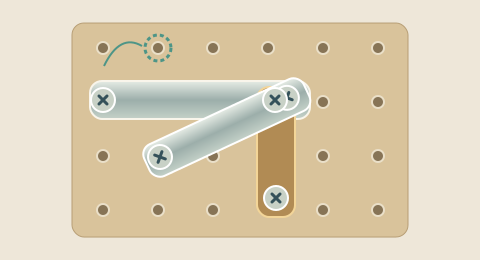
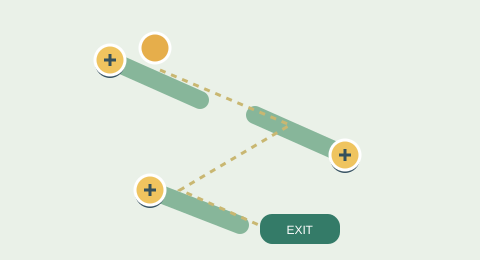
There are no layered plates or color-removal trays in this cabinet. Nuts remain visible as the collection becomes orderly. The scene uses upright threaded rods, thick hexagonal nuts and completion indicators, with a lift-and-transfer animation for each move. Play Screw Puzzle for mounting-hole mechanics or Screw Jam for rapid color decisions under buffer pressure. The shared brand connects the games, while each asks you to think about a different constraint.
Browser controls and local practice
Use a pointer or Tab and Enter to select available controls. Audio is optional. Leaving the tab pauses active play, and reduced-motion preferences shorten move transitions. On narrow screens the detailed Puzzle and Jam boards can be panned to keep screw targets readable.
The game stores its versioned move sequence on this device. Only a compatible connected service can award verified points or badges. Clear site data to remove local saves. Old versioned challenge links continue to use their original rules.
Common questions
How do I start?+
Select a rod to pick its top nut. Choose an empty rod or one topped by the same color.
What is the goal?+
Finish with full, single-color rods and empty spare rods.
Does Level 2 change the rules?+
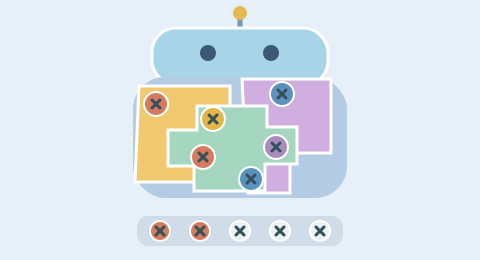
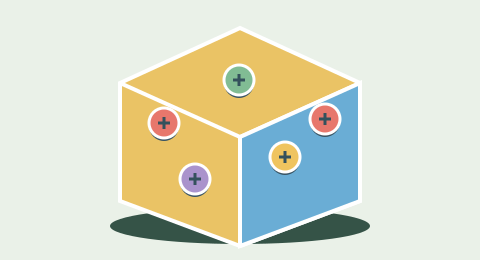
Both levels use the same core interaction. Level 2 changes the arrangement and constraints: more connected plates in Puzzle, more colors and capacity in Sort, or deeper shells and a five-slot buffer in Jam.
Can a starting layout be impossible?+
Each accepted starting layout has a complete route checked by the game rules. Later choices can still block progress. A hint search that runs out of budget is not proof that your current position is impossible.
How do Undo and Hint work?+
Current games allow one Undo and one safe Hint per run. Level 2 also offers one Rescue to add temporary space. Undo restores the preceding state without reducing cumulative moves. Hint highlights a move only when a complete continuation is found within the search budget.
Will my layout be saved?+
The current versioned move sequence is saved in this browser when local storage is available. On return, choose Continue or Start fresh. Retry keeps the seed; New layout selects a new seeded arrangement.
Does this version award points or badges?+
The games are playable as local practice. Verified points and badges require a compatible service that checks the complete move sequence.
Can I share the same challenge?+
Share layout copies a link containing the mode, engine version, level and seed. Older versioned links keep their original mechanics. A shared layout is not a verified result.